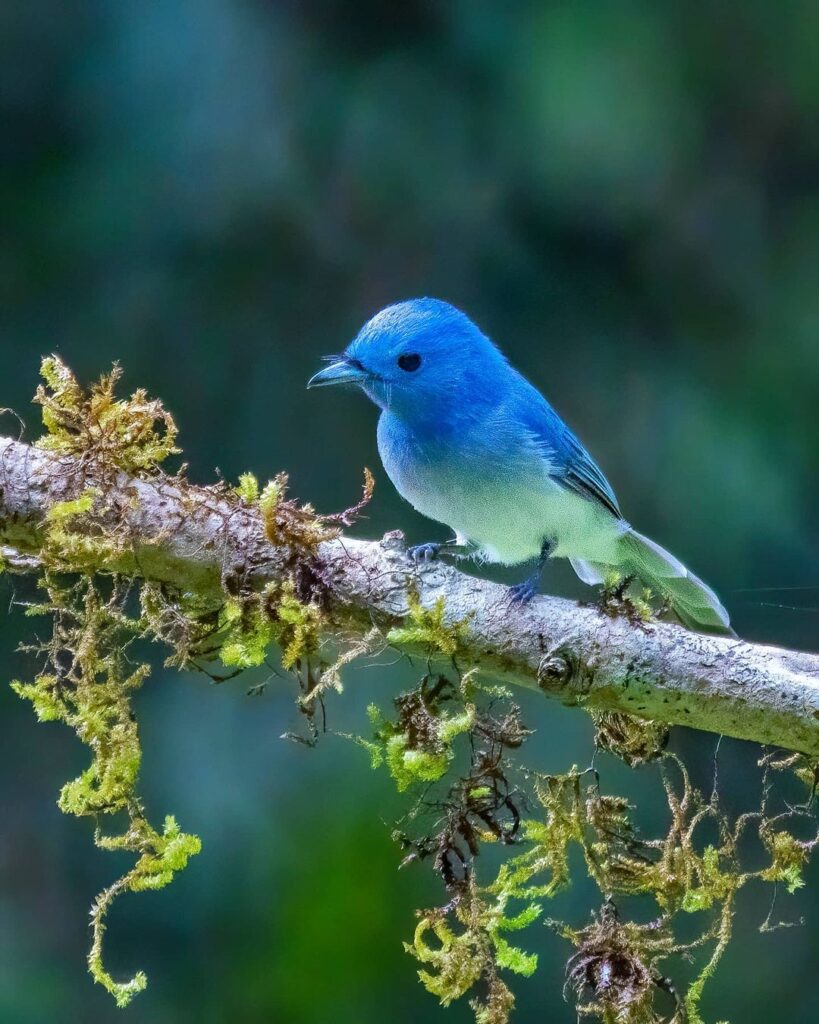
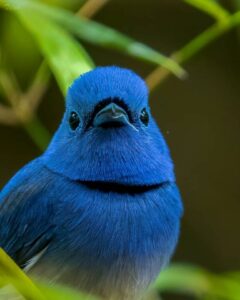
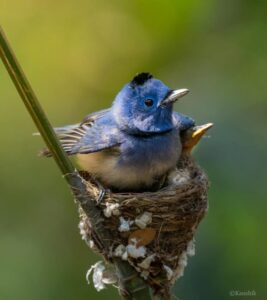
The black-naped bird is mostly blue, despite its name. Alternatively, its name may have come from its thin black collar. The situation is ambiguous in any case. You’re not alone if you’re unsure about the bird’s name. As well as being a monarch flycatcher, the bird belongs to a family of birds called thrushes.
Birds’ colors are influenced by their gender. The males are blue-colored with olive-brown wings, while the females are duller with olive-brown wings. Females do not have black spots on the backs of their heads. According to Thai National Parks, the bird measures around 16 cm in length. In addition, the color of the birds varies from region to region. Therefore, Indian and Thai birds may have different colors.
There is a similarity between the song of this bird and that of the Asian paradise flycatcher. Consequently, the bird is found in mixed-species groups. Foraging for food is done together by the flock. Carnivorous food makes up the majority of the bird’s diet. Insects that are teeny-tiny are its favorite prey. According to Singapore Birds, this is the origin of the word “black-naped blue flycatcher.”
A dry woodland area as well as a wet woodland area is good habitat for the bird. Densely forested areas are good places to see flycatchers. Trees are therefore abundant in this area. This bird breeds mostly between May and July in India. A couple of to three eggs are laid by the bird as well. The cup nests are made of very good quality materials. Branches of a tree have ‘forks’ where the nest is nested. In contrast, males destroy female nests.
The IUCN Red List classifies the flycatcher as “Least Concerned”. In contrast, this blue bird is threatened by habitat loss and other human activities. Deforestation eliminates the trees that provide them with a home. Their population has decreased as a result. Approximately 75 meters of their area have been reduced due to human activity, according to a Sri Lankan study. They are easily impacted by human activity, just like many other animals.